

Choosing the right PHP framework can save your team months of development time or create years of technical debt. When developers compare CakePHP vs. Laravel, the conversation often focuses on surface-level similarities. Both are mature PHP frameworks and have powered production applications for well over a decade.
However, looking beyond those similarities reveals two frameworks that have evolved in very different directions.
CakePHP focuses on convention-based coding and rapid development. Laravel has evolved beyond a framework into a complete development ecosystem.
Neither approach is inherently better.
For some organizations, CakePHP’s simplicity and stability make it an excellent fit. For others, Laravel’s ecosystem and built-in capabilities can dramatically accelerate development and reduce operational overhead.
In this blog, we’ll compare CakePHP and Laravel across every major area that matters: By the end, you’ll have a clear understanding of which framework aligns best with your project’s requirements and future growth plans.
What is CakePHP?
CakePHP is an open-source PHP framework first released in 2005, making it one of the longest-running PHP frameworks still under active development today.
Inspired heavily by Ruby on Rails, CakePHP helped popularize the MVC architecture within the PHP ecosystem and introduced many developers to the concept of convention-over-configuration development.
The framework’s philosophy is straightforward:
Instead of forcing developers to configure every component manually, CakePHP relies on naming conventions and predictable project structures. When developers follow those conventions, CakePHP automatically connects controllers, models, views, database tables, and other components with minimal setup.
This approach reduces boilerplate code and allows teams to focus on business logic rather than framework configuration.
As of 2026, the latest stable release is CakePHP 5x, which supports modern PHP development practices while maintaining the stability and consistency that the framework is known for.
What is Laravel?
Laravel is an open-source PHP framework created by Taylor Otwell and first released in 2011.
Over the past decade, Laravel has become the most widely adopted PHP framework in the world and is often considered the default choice for modern PHP development.
While Laravel also follows the MVC pattern, its philosophy differs significantly from CakePHP.
Rather than focusing primarily on convention-based development, Laravel emphasizes developer productivity through expressive syntax, extensive tooling, and a comprehensive ecosystem of first-party packages.
The framework aims to simplify common development challenges while providing powerful abstractions for complex application requirements.
Today, Laravel powers everything from startup MVPs to enterprise platforms, APIs, marketplaces, SaaS products, and large-scale web applications.
RELATED:
See how Laravel powers real eCommerce builds, read our full guide on
Laravel eCommerce Development Solutions for Modern Stores →
CakePHP vs Laravel at a Glance
| Feature | Laravel | CakePHP |
|---|---|---|
| Learning Curve | Moderate | Easier for beginners |
| Development Style | Ecosystem-driven and feature-rich | Convention-driven and lightweight |
| Configuration | More flexibility and customization | Less configuration required |
| Ecosystem | Extensive first-party tools and packages | Smaller but stable ecosystem |
| Admin Panels | Multiple mature solutions available | Relies mostly on third-party solutions |
| Authentication | Faster setup with built-in starter kits | More manual configuration |
| Background Processing | Advanced queue management and monitoring | Plugin-based queue support |
| Deployment Experience | Dedicated deployment platforms available | Self-managed deployment |
| Scalability Support | Extensive scaling and cloud tooling | Scales well with custom implementation |
| Community Support | Very large global community | Smaller but established community |
| Best For | SaaS, APIs, startups, rapidly growing products | Enterprise systems, internal tools, long-term maintenance |
Core Architecture: How CakePHP and Laravel Approach MVC Differently
Both frameworks implement the Model-View-Controller architecture, but their interpretation of MVC leads to different development experiences.
Laravel’s Approach
Laravel follows a structured and opinionated approach. The framework provides clear conventions for routing, authentication, validation, dependency injection, error handling, events, queues, and many other aspects of application development.
Developers generally spend less time making architectural decisions because Laravel provides established patterns for solving common problems. Even simple routes follow a consistent and expressive syntax:
php
Route::get('/dashboard', fn () => '...');
CakePHP’s Approach
CakePHP also follows convention-over-configuration principles, but it takes that philosophy further in several areas. When developers follow CakePHP’s naming conventions, many framework components connect automatically.
For example:
php
class ArticlesController extends AppController {}
Without additional configuration, CakePHP can automatically determine:
- Associated database tables
- Model classes
- Related views
- Common CRUD functionality
This reduces setup time and helps maintain consistency across large projects.
Which Is Right for You?
Neither approach is objectively superior.
- Laravel tends to appeal to teams building feature-rich applications that will continue evolving over time.
- CakePHP often appeals to organizations that value stability, consistency, and reduced configuration overhead.
The choice ultimately depends on how your team prefers to build and maintain software.
CakePHP vs Laravel Performance: What the Benchmarks Actually Tell You
Performance is often one of the first factors developers evaluate when choosing a framework. Unfortunately, many comparisons rely entirely on benchmark charts without explaining what those numbers mean in real-world applications.
The reality is that framework performance rarely determines whether an application succeeds or fails under load.
In most production environments, performance bottlenecks are caused by:
- Poor database design
- Missing indexes
- N+1 query problems
- Excessive API calls
- Lack of caching
- Inefficient application architecture
These issues can affect any framework regardless of how fast its benchmark numbers appear on paper. That context is important because both CakePHP and Laravel are capable of powering large-scale applications when implemented correctly.
CakePHP Performance
CakePHP has traditionally been known for its lightweight architecture and efficient bootstrapping process. The framework introduces relatively little overhead during request processing and performs well out of the box without requiring significant optimization.
Its ORM is feature-rich while remaining reasonably efficient, making CakePHP a strong option for traditional web applications and CRUD-heavy systems.
For applications that primarily consist of:
- Server-rendered pages
- Business management systems
- Internal enterprise tools
- Administrative dashboards
CakePHP delivers solid performance with minimal configuration.
Laravel Performance
Laravel includes significantly more functionality within the framework itself. Authentication services, event systems, service providers, middleware, dependency injection, and other components all contribute to a slightly heavier bootstrapping process.
As a result, raw benchmark comparisons sometimes show Laravel trailing behind lighter frameworks. However, benchmark numbers rarely reflect production environments.
Laravel provides multiple optimization mechanisms, including:
- Route caching
- Configuration caching
- View caching
- Query optimization
- Redis integration
- Queue processing
So, Which Framework Is Faster?
Both frameworks are capable of excellent performance. The practical takeaway is simple:
- CakePHP performs extremely well out of the box.
- Laravel performs similarly for most applications.
- Laravel can outperform CakePHP under high traffic when Octane is implemented.
- Database optimization has a far greater impact than framework selection.
For most businesses, performance should not be the primary deciding factor between CakePHP and Laravel.
Built-In Features and Capabilities: A Detailed CakePHP vs Laravel Comparison
While both frameworks cover the fundamentals well, this is where their differences become more noticeable. No individual feature creates a massive gap between the frameworks. Instead, the distinction emerges through the accumulation of small advantages across multiple areas of development.
1. Routing
Routing is one of the most frequently used components in any web application. A routing system determines how incoming requests are mapped to application logic and plays a major role in maintainability as projects grow.
Laravel Routing
Laravel provides a highly expressive routing system that includes the following:
- Named routes
- Resource controllers
- Middleware groups
- Route model binding
- Route caching
- API routing support
A simple protected route can be defined as
php
Route::middleware('auth')
    ->get('/dashboard', fn () => '...');
One of Laravel’s biggest advantages is route model binding. Instead of manually fetching records inside controllers, Laravel automatically resolves models based on route parameters. This reduces boilerplate code and keeps controllers cleaner.
CakePHP Routing
CakePHP’s routing system is mature, reliable, and well documented. It supports:
- Named routes
- Route scopes
- Route prefixes
- RESTful routing
- Custom route classes
Example:
php
$routes->connect(
    '/dashboard',
    ['controller' => 'Dashboard', 'action' => 'index']
);
CakePHP handles routing effectively, but Laravel’s route model binding and middleware integration generally result in a more streamlined developer experience.
Routing Verdict: Both frameworks provide capable routing systems. Laravel offers slightly greater flexibility and developer convenience, particularly in larger applications.
2. Database and ORM
Database interaction is one of the most important aspects of any framework. This is also one of the few areas where CakePHP competes directly with Laravel rather than trailing behind it.
CakePHP ORM
CakePHP’s ORM is highly capable and supports advanced relational data handling. Features include:
- Associations
- Query builders
- Validation
- Behaviors
- Eager loading
- Custom finders
Example:
php
$articles = $this->Articles
    ->find()
    ->where(['published' => true])
    ->all();
The ORM follows a hybrid approach that combines aspects of Active Record and Data Mapper patterns. This provides flexibility while maintaining a relatively clean API.
Laravel Eloquent ORM
Laravel’s Eloquent ORM is widely considered one of the framework’s strongest features.
Example:
php
Article::where('published', true)->get();
Eloquent emphasizes readability and developer productivity. Its biggest advantage is not necessarily its query syntax, but its deep integration with the rest of Laravel. Eloquent works seamlessly with:
- API Resources
- Queues
- Events
- Notifications
- Validation
- Authorization Policies
This creates a highly cohesive development experience.
ORM Verdict:: Both ORMs are excellent. CakePHP’s ORM is powerful, mature, and perfectly capable of supporting enterprise applications. Laravel’s Eloquent gains a slight advantage because of its ecosystem integration and widespread community adoption.
3. Authentication
Authentication is an area where Laravel has invested heavily over the years. Modern applications frequently require the following:
- User registration
- Login systems
- Password resets
- API authentication
- Multi-device access
- Session management
Laravel provides multiple solutions depending on project requirements.
Laravel Authentication
The ecosystem includes:
- Sanctum
- Breeze
- Jetstream
- Passport
Protecting routes is straightforward:
php
Route::middleware('auth:sanctum')
    ->get('/user', fn ($request) => $request->user());
Developers can implement sophisticated authentication systems with relatively little configuration.
CakePHP Authentication
CakePHP provides an Authentication Plugin and Authorization Plugin that support:
- Session authentication
- Token authentication
- Access control
- User permissions
The functionality is solid and production-ready. However, developers typically perform more manual configuration compared to Laravel’s streamlined approach.
Authentication Verdict: CakePHP provides everything required to secure modern applications. Laravel simply reaches that destination faster through its first-party ecosystem.
4. Security Defaults
Security is non-negotiable for modern web applications. Both frameworks take security seriously and provide protections against common vulnerabilities.
Laravel Security
Laravel includes:
- CSRF protection
- Password hashing
- Encryption
- Rate limiting
- Input validation
- Authorization policies
Validation is integrated directly into the request lifecycle:
php
$request->validate([
    'email' => 'required|email'
]);
Because many security features are enabled by default, Laravel encourages secure development practices from the beginning.
CakePHP Security
CakePHP also provides strong security features, including:
- CSRF protection
- XSS filtering
- Input validation
- Form tampering protection
- Secure password hashing
The framework’s security capabilities are excellent. The difference is that developers often need to configure more components manually.
Security Verdict: Both frameworks can support highly secure applications. Laravel provides a stronger default security posture, while CakePHP offers comparable protection with slightly more configuration effort.
5. Error Handling and Logging
As applications grow, monitoring and debugging become increasingly important.
Laravel
Laravel automatically captures exceptions and integrates cleanly with the following:
- Monolog
- Sentry
- Bugsnag
- New Relic
- Custom logging channels
Its exception handling system is highly extensible and easy to configure.
CakePHP
CakePHP includes reliable error handling and logging capabilities. Developers can customize logging behavior and integrate third-party monitoring tools. While entirely capable, the ecosystem surrounding Laravel generally provides more plug-and-play monitoring options.
6. Testing
Testing often becomes a deciding factor for larger teams and long-term projects.
Laravel Testing
Laravel includes:
- PHPUnit integration
- HTTP testing helpers
- Database testing
- Factories
- Mocking support
- Browser testing via Dusk
Example:
php
$this->get('/dashboard')
    ->assertStatus(200);
Laravel’s testing experience is widely considered one of the best in the PHP ecosystem.
CakePHP Testing
CakePHP supports PHPUnit and offers a solid testing framework. Developers can write unit tests, integration tests, and application tests with relative ease. The tooling has improved significantly in recent versions. However, Laravel’s testing ecosystem remains more extensive and polished.
Testing Verdict: Both frameworks support professional testing workflows. Laravel provides the more mature and developer-friendly testing experience.
Testing Verdict:Both frameworks support professional testing workflows. Laravel provides the more mature and developer-friendly testing experience.
7. Task Scheduling and Background Jobs
Modern applications increasingly rely on asynchronous processing. Examples include:
- Payment processing
- Email delivery
- Data imports
- Report generation
- Notifications
- Image processing
Laravel Queues
Laravel includes a powerful queue system with support for:
- Redis
- Amazon SQS
- Database drivers
- Beanstalked
Additional features include:
- Retry handling
- Failed job tracking
- Job batching
- Queue prioritization
- Horizon monitoring
Task scheduling is equally powerful:
php
$schedule->command('emails:send')
        ->daily();
CakePHP Queues
CakePHP offers queue functionality through plugins and community-supported packages. These solutions work well for many applications and cover most common use cases. However, they do not provide the same depth of tooling, monitoring, and first-party support available within Laravel.
Background Processing Verdict: For applications heavily dependent on asynchronous processing, Laravel has a clear advantage. Its queue infrastructure is more mature, better integrated, and easier to scale.
The Laravel Ecosystem in 2026: Why It Changes the Comparison
A framework comparison alone doesn’t fully explain Laravel’s position in the PHP ecosystem today.
When Laravel first appeared, it competed primarily on developer experience. In 2026, the conversation is broader. Laravel is no longer just a framework; it has evolved into an ecosystem of tools that address many of the challenges developers face throughout an application’s lifecycle.
This matters because framework selection affects more than code. It also influences deployment workflows, team productivity, maintenance costs, infrastructure decisions, and long-term scalability.
For many organizations, the ecosystem surrounding Laravel has become just as important as the framework itself.
Filament and Livewire
One of the biggest developments in recent years has been the rise of Filament.
Filament has become one of the most widely adopted admin panel solutions in the PHP ecosystem, allowing teams to build dashboards, CRM systems, internal tools, and administrative interfaces significantly faster than traditional development approaches.
Built on Livewire, Filament allows developers to create highly interactive interfaces while staying within the Laravel ecosystem.
class ArticleResource extends Resource
{
    protected static ?string $model = Article::class;
}
Instead of spending weeks building administrative functionality from scratch, teams can often generate robust back-office systems in a fraction of the time.
For organizations that frequently build dashboards, management portals, and internal business tools, this productivity gain can have a meaningful impact on project timelines.
Laravel Cloud, Forge, and Vapor
Deployment is often one of the most challenging parts of application development.
Laravel addresses this challenge through several first-party solutions.
Laravel Forge
Forge simplifies server provisioning and deployment management.
It handles:
- Server setup
- SSL certificates
- Deployment automation
- Queue management
- Scheduled tasks
Laravel Vapor
Vapor provides a serverless deployment platform built on AWS.
Organizations can benefit from:
- Automatic scaling
- Reduced infrastructure management
- High availability
- Pay-as-you-go resource usage
Laravel Cloud
Laravel Cloud extends this approach further by providing a fully managed platform designed specifically for Laravel applications.
For teams that want to focus on application development rather than infrastructure management, these services can significantly reduce operational complexity.
Livewire v4 and Inertia 2.0
Frontend development has become increasingly complex over the past decade.
Many organizations struggle with maintaining separate backend and frontend applications while keeping APIs synchronized across multiple teams.
Laravel offers two distinct approaches to solving this challenge.
Livewire
Livewire enables developers to create highly interactive interfaces while keeping application logic primarily in PHP.
Recent releases have introduced the following:
- Single-file components
- Improved reactivity
- Better performance
- Simplified component development
This approach appeals to teams that want modern user experiences without maintaining a large JavaScript codebase.
Inertia
Inertia takes a different approach.
It allows Laravel applications to work seamlessly with frameworks such as:
- React
- Vue
- Svelte
Developers gain the advantages of modern frontend frameworks without needing to build a separate API-driven architecture.
Laravel 12
Laravel 12 continues to refine the developer experience with improvements across multiple areas.
Highlights include:
- Official React starter kits
- Official Vue starter kits
- Livewire starter kits
- Tailwind CSS v4 support
- Vite v6 integration
- Improved caching
- Enhanced health monitoring
- Per-second rate limiting
Route::middleware('throttle:60,1')
    ->group(function () {
        // Routes
    });
These enhancements further strengthen Laravel’s position as a platform designed for modern application development
The CakePHP Ecosystem in 2026: What It Does Well
Teams that evaluated CakePHP years ago and dismissed it should take a fresh look at CakePHP 5.x. It is a modern, well-maintained framework with a clear sense of purpose.
CakePHP 5 requires PHP 8.1 or newer, is fully namespace-aware, Composer-integrated, and PSR-compliant. It is not legacy software running in compatibility mode. It is a deliberately focused framework for teams that value stability, fast scaffolding, and a lower learning curve.
Where CakePHP genuinely excels in 2026:
- Rapid prototyping through code generation: CakePHP’s bake command generates controllers, models, templates, and tests from the command line. A developer can scaffold an entire CRUD interface in minutes. This is one area where CakePHP’s tooling is genuinely faster than Laravel’s out-of-the-box experience.
- Low learning curve for PHP developers: A PHP developer with no prior framework experience can become productive in CakePHP quickly. The naming conventions are logical, the documentation is thorough, and the framework does not require understanding service containers, facades, or complex dependency injection setups to get started.
- Stability and predictability: CakePHP has maintained a consistent API philosophy over many versions. Teams that have built on CakePHP know what to expect between releases, and the upgrade path between major versions is generally well-managed.
- Enterprise-grade conventions: CakePHP was originally built with enterprise PHP development in mind. Its conventions around multi-tenancy, plugin architecture, and access control have a long history in large, complex applications.
- Shared hosting compatibility: CakePHP runs comfortably on standard hosting environments. Laravel functions on shared hosting but benefits considerably from dedicated or cloud infrastructure with proper PHP configuration.
It is also worth noting that CakePHP 3 and earlier reached end of life some time ago. Organizations still running older CakePHP versions face real security and compliance risk.
The path forward is CakePHP 5, not a lateral move to an older version of another framework.
Scalability and Long-Term Architecture: CakePHP vs Laravel for Growing Applications
Both frameworks support horizontal scaling, but they approach it with different levels of built-in tooling.
Laravel is designed with scale in mind at the architecture level. First-party support covers queue workers, event broadcasting, Redis caching, job batching, and database connection pooling.
Laravel Vapor, in particular, scales automatically without requiring teams to manage server capacity. For applications that anticipate significant growth, Laravel turns scaling into a configuration decision rather than a development project.
CakePHP scales effectively, but it requires more manual work. Caching, load balancing, and distributed job processing are handled through community plugins or custom implementation rather than first-party tooling.
The lightweight core is an advantage at the individual server level, but the absence of managed scaling tooling becomes a constraint as traffic grows unpredictably.
To summarize the practical distinction:
- For steady, predictable traffic, CakePHP’s approach is entirely workable
- For rapid or unpredictable growth, Laravel’s infrastructure tooling reduces risk and development effort considerably.
Which PHP Framework Should You Choose?
After comparing architecture, performance, features, ecosystem support, and scalability, the decision becomes much clearer.
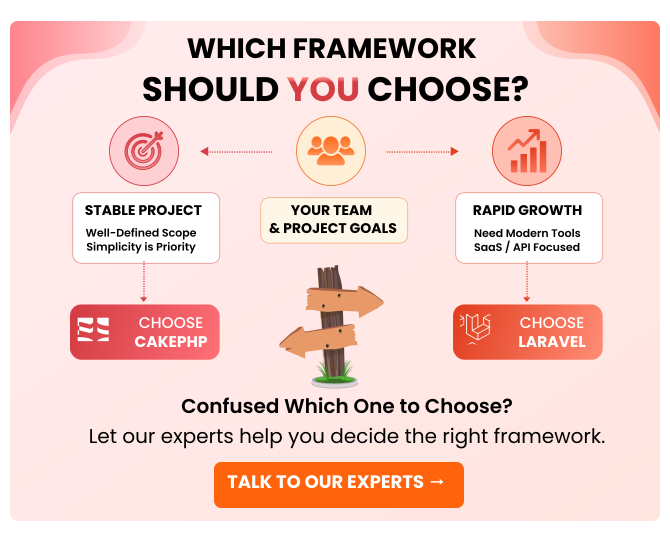
Choose Laravel If:
Laravel is generally the stronger choice when:
- You’re building a SaaS product
- You need API development
- Real-time functionality is important
- Your application is expected to grow significantly
- You rely heavily on background processing
- You want access to a large developer community
- Hiring experienced developers is a priority
- You prefer a rich ecosystem of integrated tools
Laravel excels in projects where growth, flexibility, and developer productivity are major priorities.
Choose CakePHP If…
CakePHP is often the better choice when:
- Your team already has CakePHP expertise
- The project scope is well-defined and stable
- Long-term maintainability is a primary concern
- Simplicity is more important than ecosystem size
- Enterprise stability is a key requirement
- You prefer convention-driven development
- You’re extending an existing CakePHP application
CakePHP continues to provide a reliable and efficient foundation for many business applications.
Conclusion
Both CakePHP and Laravel are proven PHP frameworks with their own strengths. CakePHP offers simplicity and stability, while Laravel provides a larger ecosystem and more built-in tools for modern application development.
Rather than focusing on which framework is better, focus on which one best fits your application’s needs, development workflow, and future growth plans.
Need help choosing the right framework for your next project? Contact us to discuss your requirements and build a solution tailored to your business.
FAQs
1. Which framework has a larger community?
Laravel has a much larger community, providing more learning resources, packages, and third-party integrations.
2. Which framework is better for startups?
Laravel is typically the preferred choice for startups because it enables faster development and easier scalability.
3. Which framework is easier to learn?
CakePHP is generally easier for beginners due to its convention-based approach and lower configuration requireme
4. Is Laravel better than CakePHP?
Laravel offers a larger ecosystem and more built-in tools, while CakePHP focuses on simplicity and stability. The better choice depends on your project needs.
5. Is CakePHP still relevant in 2026?
Yes. CakePHP is actively maintained and remains a reliable choice for enterprise and business applications.