


The offshore PHP developer market is worth over $122 billion and projected to reach $283 billion by 2031, according to Verified Market Research.
PHP powers approximately 75% of all websites with a known server-side language (W3Techs), from WordPress and Drupal to production-grade Laravel and Symfony applications running at enterprise scale. The demand for PHP talent hasn’t slowed, but the way teams hire has changed significantly.
The strongest offshore PHP developers work across Laravel, Symfony, and CodeIgniter; write modern PHP 8.x with typed properties, enums, and fibers; and use AI-assisted development tools like Cursor and Claude Code alongside traditional environments like PHPStorm.
Rates range from $20 per hour in India and the Philippines to $60 per hour in Poland and Latin America, compared to $80 to $200 per hour for equivalent talent in the United States.
What Is an Offshore PHP Developer?
An offshore PHP developer is a software engineer who specializes in PHP and its frameworks (typically Laravel, Symfony, or CodeIgniter) and works remotely from a country with lower labor costs than the hiring organization’s home market.
The “offshore” distinction refers specifically to developers located in a different time zone, usually with a 5 to 12-hour gap from the client.
Worth distinguishing from related terms:
| Term | What it means | Typical zone gap |
| Offshore | Developer in a distant country (e.g., US client hiring in India, Philippines, or Vietnam) | 8 to 12 hours |
| Nearshore | Developer in a nearby country with a similar timezone (e.g., US client hiring in Colombia, Mexico, or Argentina) | 1 to 4 hours |
| Onshore/local | A developer in the same country | 0 to 3 hours |
| Remote | Any non-colocated developer, regardless of country | Varies |
Why Hiring Offshore PHP Developers Makes Sense in 2026
PHP’s position in the technology stack has not weakened. Three market realities drive the ongoing demand for offshore PHP talent:
The installed base is enormous: PHP runs the server-side logic for roughly three out of four websites on the internet. WordPress alone powers over 40% of the web and runs entirely on PHP. Every one of those installations needs maintenance, security updates, plugin development, and performance optimization. The demand for PHP developers is structural, not cyclical.
Laravel has become enterprise-grade: Laravel’s ecosystem (Eloquent ORM, Blade templating, Horizon, Queues, Forge, Envoyer, and Vapor for serverless) now supports applications at a scale that would have required Java or .NET a decade ago. Teams building SaaS products, B2B platforms, and internal tools on Laravel need developers who understand the framework deeply, not just the language.
The cost gap remains significant: A senior Laravel developer in the United States commands $80 to $150 per hour. The same skill set in Ukraine costs $35 to $55. In India, $25 to $45. In the Philippines, $20 to $35. For a team of three developers working full-time, that difference compounds to $200,000 to $500,000 per year in savings, without accounting for benefits, office space, and hiring overhead.
Modern PHP is not legacy PHP: PHP 8.x introduced typed properties, named arguments, enums, fibers, read-only classes, match expressions, and union/intersection types. A developer writing PHP 8.3 or 8.4 is working in a language that bears little resemblance to the PHP 4 or 5 that gave the language its “messy” reputation. Evaluating offshore PHP developers in 2026 means evaluating their fluency with modern PHP, not just whether they can write procedural scripts.
What Skills to Look for in an Offshore PHP Developer in 2026
The skills that separate a productive offshore PHP developer from an expensive mistake fall into four tiers. Screen in this order:
Core PHP proficiency
- PHP 8.x features: typed properties, enums, readonly properties, fibers, match expressions, union and intersection types, named arguments
- Object-oriented programming: interfaces, abstract classes, traits, dependency injection, SOLID principles
- Error handling: exceptions, custom exception hierarchies, graceful degradation
- Performance: OPcache configuration, profiling with Xdebug, query optimization, caching strategies (Redis, Memcached)
Framework depth (match to your stack)
- Laravel: Eloquent ORM, Blade templating, Artisan CLI, Queues and Horizon, Events and Listeners, Middleware, API Resources, Laravel Sanctum/Passport for authentication, testing with PHPUnit and Pest
- Symfony: Doctrine ORM, Twig templating, Messenger component, Dependency Injection Container, Flex recipes, Symfony Console
- CodeIgniter: MVC architecture, Active Record, lightweight applications
- CMS-specific: WordPress plugin/theme development (hooks, filters, custom post types, REST API), Drupal module development, Magento (Adobe Commerce) extension development
Infrastructure and DevOps literacy
- Version control: Git workflow (feature branching, pull requests, rebasing)
- Containerization: Docker for local development, Docker Compose for multi-service setups
- CI/CD: GitHub Actions, GitLab CI, or Bitbucket Pipelines for automated testing and deployment
- Deployment: Laravel Forge, Envoyer, or manual server provisioning
- Database administration: MySQL, PostgreSQL, MariaDB, Redis, query optimization, migration management
Offshore PHP Developer Rates by Country: The 2026 Table
Offshore PHP developer rates in 2026 vary by country, seniority, and engagement model. The ranges below are PHP-specific (not generic “software development” rates) and reflect freelancer and dedicated-team pricing across multiple data sources, including Upwork, Arc.dev, Turing, and regional salary surveys.
| Country | Junior (1-3 yrs) | Mid-level (3-6 yrs) | Senior (6+ yrs) | Timezone to US EST | English proficiency |
| India | $15-$25/hr | $25-$35/hr | $35-$50/hr | +9.5 to +10.5 hrs | Good (varies) |
| Philippines | $12-$20/hr | $20-$30/hr | $30-$40/hr | +12 to +13 hrs | Strong |
| Vietnam | $15-$22/hr | $22-$35/hr | $35-$45/hr | +11 to +12 hrs | Moderate |
| Ukraine | $20-$30/hr | $30-$45/hr | $45-$60/hr | +7 hrs | Strong |
| Poland | $25-$35/hr | $35-$50/hr | $50-$65/hr | +6 hrs | Strong |
| Romania | $20-$30/hr | $30-$40/hr | $40-$55/hr | +7 hrs | Strong |
| Argentina | $20-$30/hr | $30-$45/hr | $45-$60/hr | +2 hrs | Strong |
| Colombia | $18-$25/hr | $25-$40/hr | $40-$55/hr | 0 hrs | Good |
| Mexico | $18-$28/hr | $28-$42/hr | $42-$60/hr | -1 to +1 hr | Good |
| Brazil | $18-$25/hr | $25-$38/hr | $38-$55/hr | +2 hrs | Moderate |
| Egypt | $12-$20/hr | $20-$30/hr | $30-$45/hr | +7 hrs | Good |
| Bangladesh | $10-$18/hr | $18-$28/hr | $28-$40/hr | +10 hrs | Good (varies) |
| United States (comparison) | $45-$70/hr | $70-$120/hr | $120-$200/hr | — | Native |
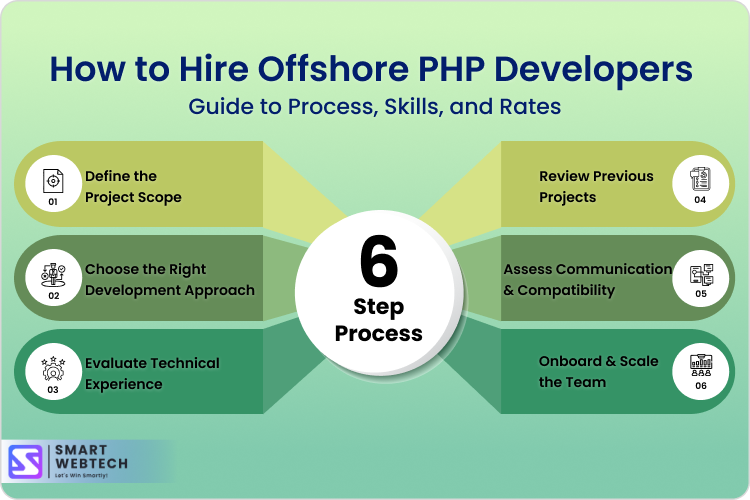
The 6-Step Process to Hire Offshore PHP Developers
Hiring offshore PHP developers becomes much easier when the process is structured correctly. Instead of spending months comparing freelancers, platforms, and multiple hiring channels, businesses should focus on technical fit, communication, and long-term collaboration. A streamlined hiring process reduces delays, improves development quality, and helps teams scale faster.
Step 1: Define the Project Scope
Start by clearly outlining what you need to build or maintain. This includes the PHP framework, project goals, integrations, timeline, and expected deliverables. A Laravel SaaS application, a custom CRM, or a WordPress platform all require different technical expertise, so defining the scope early helps identify the right developers faster.
Step 2: Choose the Right Development Approach
Rather than managing dozens of individual candidates, many businesses simplify hiring by working with an experienced development partner that already has vetted PHP developers and established workflows. This reduces hiring overhead, improves communication, and helps projects move faster from planning to execution.
Step 3: Evaluate Technical Experience
Focus on developers who have real-world experience with modern PHP development. Strong candidates should understand PHP 8.x, Laravel or Symfony, API integrations, databases, Git workflows, and scalable backend architecture. Practical production experience matters far more than theoretical interview knowledge.
Step 4: Review Previous Projects
Before moving forward, review the developer’s past work, GitHub repositories, or live applications. This helps evaluate coding standards, architecture decisions, and overall development quality. Developers who have maintained real production systems usually adapt more effectively to ongoing projects.
Step 5: Assess Communication and Workflow Compatibility
Technical skills alone are not enough for successful offshore collaboration. Communication quality, responsiveness, documentation habits, and the ability to understand project requirements all play a major role in long-term project success.
Step 6: Onboard and Scale the Team
Once the developer proves to be a good fit, move into structured onboarding with clear workflows, project access, and communication processes. As the project grows, the team can scale gradually based on business requirements and delivery goals.
Looking for offshore PHP developers?
Hiring offshore PHP developers is one of the most cost-effective ways to scale your development capacity, but the process matters as much as the talent.
Smart WebTech has been delivering custom web, mobile, and automation solutions for over a decade, with a development team experienced in Laravel, Symfony, WordPress, and modern PHP 8.x.
Whether you need a dedicated PHP development team for an ongoing product, a specialist for a legacy migration, or additional capacity for a time-sensitive build, we can match the right developers to your project and manage the engagement from kickoff through delivery.
Get in touch to discuss your requirements and team structure.