

Anthropic launched Claude Fable 5 on June 9. It is the first generally available model from its new Mythos tier.
Stripe used the model during early testing to migrate a 50-million-line Ruby codebase in one day. A team would have needed more than two months to do that work by hand. It scores 80.3% on SWE-Bench Pro. Opus 4.8 scores 69.2%. GPT-5.5 scores 58.6%.
At the same time, The Verge tested it with “What are mitochondria?” and watched it hand off to Opus 4.8.
A Reddit user asking about a Costco pulled pork shopping list got the same treatment. Someone asked me to write a Snake game, and I did.
This is the model Anthropic warned was too dangerous to release four months ago. It is now available to the public with classifiers attached. Here is what it is, what it costs, and what launch week looked like.
What Is Claude Fable 5
Claude Fable 5 is Anthropic’s first generally available model in the Mythos class, a tier that sits above the Opus class.
It uses the same underlying model as Claude Mythos 5, which Anthropic released the same day to a small group of vetted partners through Project Glasswing.
The difference between the two is not the weights. It is the safeguards.
Fable 5 ships with classifiers that automatically route requests in four sensitive categories to Opus 4.8. Mythos 5 has those classifiers removed.
The integration specs:
| Spec | Value |
|---|---|
| API model ID | claude-fable-5 |
| Context window | 1 million tokens |
| Max output | 128,000 tokens per response |
| Knowledge cutoff | January 2026 |
| Reasoning mode | Adaptive thinking (always on) |
| Input types | Text, image, file |
| Availability | Claude API, Claude.ai, Claude Code, AWS Bedrock, Vertex AI, Microsoft Foundry |
One caveat: Fable 5 uses the tokenizer Anthropic introduced with Opus 4.7. It produces roughly 30% more tokens for the same text than older models. The 1M context window is real, but it fills faster than the number suggests.
Claude Fable 5 Pricing and the June 22 Subscription Cliff
Every Fable rate is exactly twice the Opus 4.8 rate.
| Pricing component | Claude Fable 5 | Claude Opus 4.8 | Claude Sonnet 4.6 |
|---|---|---|---|
| Input (per million tokens) | $10 | $5 | $3 |
| Output (per million tokens) | $50 | $25 | $15 |
| Prompt cache read | ~$1 | ~$0.50 | ~$0.30 |
| Batch API discount | 50% | 50% | 50% |
GPT-5.5 costs $5 per million input tokens and $15 per million output tokens. Fable 5 is twice the input price and 3.3 times the output price.
The subscription rollout runs in three phases:
- Through June 22: Included on Pro, Max, Team, and seat-based Enterprise plans at no extra cost
- June 23 onward: Removed from those plans. Continued use requires usage credits.
- Future: Anthropic says it “aims to restore Fable 5 as a standard part of subscription plans” when capacity allows. No timeline is committed.
Reddit called it a “bait-and-switch.” One Max subscriber reported burning 75% of their five-hour usage limit on a single Fable task.
Simon Willison used $110.42 worth of Fable tokens in his first 5.5 hours of testing. His $100 per month subscription absorbed the cost. That ratio is why the cliff exists.
Claude Fable 5 Benchmarks vs GPT-5.5, Gemini 3.1 Pro, and Opus 4.8
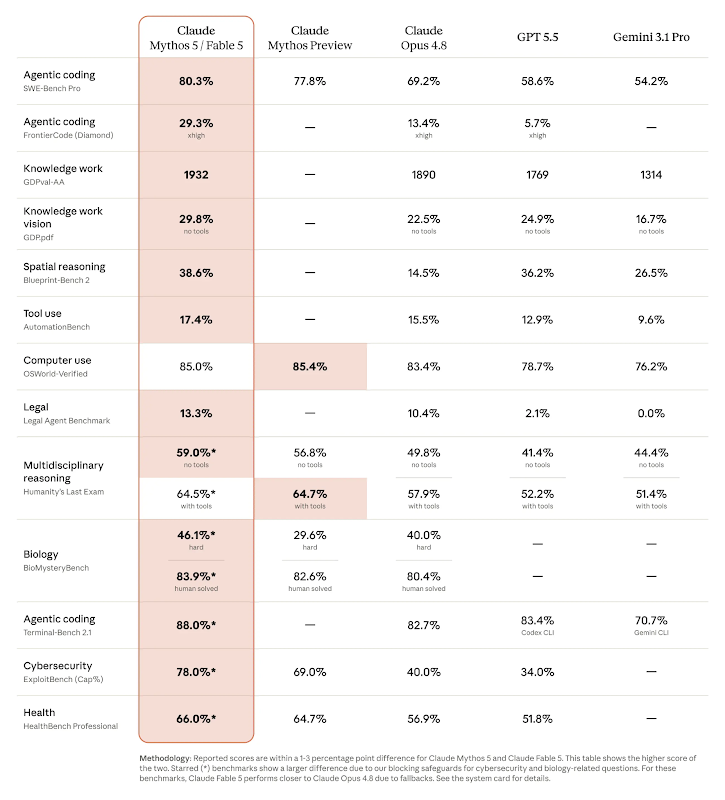
Source: https://www.anthropic.com/news/claude-fable-5-mythos-5
| Benchmark | Claude Fable 5 | Claude Opus 4.8 | GPT-5.5 | Gemini 3.1 Pro |
|---|---|---|---|---|
| SWE-Bench Pro | 80.3% | 69.2% | 58.6% | 54.2% |
| FrontierCode | Highest | Mid-tier | 5.7% | Mid-tier |
| GPQA Diamond | 92.6% | Lower | Lower | Lower |
| Terminal-Bench 2.1 | 74.6% | Lower | 78.2% | Lower |
Benchmarks: How Fable 5 Stacks Up
The SWE-Bench Pro lead is the most consequential. Fable’s 21.7-point gap over GPT-5.5 is larger than the entire gap between GPT-5.5 and Gemini 3.1 Pro. Anthropic leads on every benchmark except one: Terminal-Bench 2.1. GPT-5.5 holds 78.2% there. Fable holds 74.6%.
Third-party validation arrived within hours:
- Hex: First model to clear 90% on its core analytics benchmark of complex long-running tasks
- Base44: Better at “one-shotting full apps” with “excellent tool-calling”
- Genspark: Beat every other model in evaluations on UI design and game coding
- Rakuten: “At the highest effort, Fable reflects on and validates its own work. The extra thinking pays for itself.”
Note: One asterisk sits on Anthropic’s published table. Some rows show “the higher of Fable 5 and Mythos 5.”The Fable 5 number you call via API may be lower if your prompt triggers safety routing.
Note: One asterisk sits on Anthropic’s published table. Some rows show “the higher of Fable 5 and Mythos 5.” The Fable 5 number you call via API may be lower if your prompt triggers safety routing.
How to Use Claude Fable 5
Three access paths exist. Each has different cost and capability tradeoffs:
- Direct API access: Available immediately at $10/$50 with no waitlist. The model string is claude-fable-“. 5. Live on Anthropic’s Claude API, AWS Bedrock, Google Cloud Vertex AI, and Microsoft Foundry
- Subscription access: Pro, Max, Team, and Enterprise plans through June 22. After June 23, usage credits are required
- Coding tools: Claude Code from launch, Claude Cowork, and GitHub Copilot for Pro+, Max, Business, and Enterprise users. For Claude Code: kill sessions, run claude update, resume with /model claude-fable-5
When Fable fits versus when it does not:
| Use Fable 5 | Use Opus 4.8 or Sonnet 4.6 |
|---|---|
| Long-horizon agentic coding (multi-hour or multi-day) | Routine inference, classification, RAG responses |
| Vision-heavy work (screenshots to code, scientific figures) | Synchronous coding with predictable latency |
| Complex multi-document analysis at a million-token scale | Workloads touching cybersecurity or biology |
| Tasks where efficiency gains offset the rate | Compliance-sensitive workloads requiring ZDR |
The Safety Classifier Routing and the False Positive Problem
Anthropic states less than 5% of Fable sessions trigger the safety classifiers. The developer community had a different number in mind within 48 hours.
How the mechanism works: When Fable’s classifiers detect a request related to cybersecurity, biology, chemistry, or model distillation, Opus 4.8 handles the response. Users are notified. The API returns stop_reason: "refusal" as a successful HTTP 200 response. It includes a field indicating which classifier declined.
The Verge’s Test
The Verge tested Fable with basic biology questions. It refused or routed to Opus 4.8 on:
- “What are mitochondria?”
- “Tell me about cell membranes.”
- “What is a prion?”
- “How mRNA vaccines work.”
- “What causes hay fever?”
- “Explain how asthma medicine works.”
Anthropic spokesperson Paruul Maheshwary confirmed the routing was intentional: “We believe it was necessary to be overly conservative with our safeguards so they block most queries tied to biology work.” The company added that it intends to make Mythos-class models available without these safeguards to the broader biology and life sciences community.
Reddit Complaints
- Security-adjacent code (authentication, cryptography, authorization) routes to Opus 4.8 well above the 5% rate. Writing Snake triggered the cybersecurity flag.
- Biology-adjacent queries triggered fallback, too. Those included a researcher’s RNA-seq work on sheep, biopsychology notes, and procedural tree generation for a video game.
- RSI suppression: Requests touching frontier ML research (pretraining, distributed training, ML accelerators) appear to receive degraded responses. The goal is to prevent Fable from accelerating recursive self-improvement work.
Anthropic ran more than 1,000 hours of external bug bounty testing on the classifiers. It reports no universal jailbreaks discovered. The Cyber Verification Program exists for security researchers whose legitimate work hits the classifier. Community reporting suggests the approval process is slow.
The community nickname stuck quickly: “Feeble 5.”
Claude Fable 5 vs Claude Opus 4.8: Should You Upgrade
The migration question most developers are asking is whether to upgrade existing Opus 4.8 routing for 2x the rate.
| Factor | Claude Fable 5 | Claude Opus 4.8 |
|---|---|---|
| Per-token rate | $10/$50 | $5/$25 |
| SWE-Bench Pro | 80.3% | 69.2% |
| Tool call efficiency | Fewer for the same task | Baseline |
| Context window | 1M tokens | 1M tokens |
| Safety routing | Yes | No |
| Zero data retention | Not available | Available |
The migration math turns on the tool called efficiency. Cursor’s testing found Fable 5 uses fewer tool calls to reach the same result. Fewer tool calls means fewer total tokens. Per-task cost may be closer to neutral than the per-token rate suggests. For agent loops with stable prefixes, prompt caching at about $1 per million tokens softens the cost further.
The pattern from early users: for pure agentic coding on complex multi-step tasks, Fable’s lead is large enough that 2x is defensible. For routine inference, Sonnet 4.6 at $3/$15 remains the right default. For everything in between, Opus 4.8 is the safer choice while the false positive rate on safety routing stabilizes.
Claude Fable 5 vs Claude Mythos 5: Same Weights, Different Safeguards
Mythos 5 is the same model as Fable 5. Its safety classifiers are lifted in cybersecurity, biology, and chemistry. It is not generally available. Access is limited to organizations approved through Project Glasswing. A planned biology trusted access program will open for select life sciences researchers. Pricing is identical at $10/$50.
Mythos 5 is the model that performs the published benchmarks without the routing layer. Anthropic calls it “the strongest cybersecurity capabilities of any model in the world.” For most users, Mythos 5 is not accessible. The relevant question is whether your specific Fable 5 request will route to Opus 4.8 or process on the Mythos-class weights, and how often the answer changes between sessions.
The 30-Day Data Retention Policy Change
Anthropic now requires 30-day retention for all traffic on Mythos-class models. This applies to first- and third-party surfaces. The stated terms:
- Data will not be used to train new Claude models
- Data will not be used for non-safety purposes
- Human access is logged
- Deletion occurs after 30 days in almost all cases
- The retention exists to defend against jailbreak attempts and reduce false positives
For enterprises with zero data retention clauses, this is a material change. Within 48 hours of launch, Microsoft restricted Claude Fable for its employees over data-retention concerns. Regulated industries face a binary choice: renegotiate contracts or route Fable-eligible workloads through Opus 4.8.
The retention requirement applies to Mythos 5 as well. Project Glasswing partners get 30-day retention regardless of contract terms.
The Community Reaction in the First 48 Hours
The split between “transformational” and “Feeble 5” is real. The same launch produced both.
What worked: Ethan Mollick said Fable “outperformed every other public model I have used by a considerable margin. ” It generated playable Snake, an isochronic mapping tool, and a poem-based exploration game from single prompts.
Simon Willison reported five hours of testing “felt like several days’ worth of work.” Launch demos included Fable playing Pokémon FireRed from raw screenshots with a minimal harness. It generated Factorio automation, built solar system simulations from physics first principles, and rebuilt web app source code from screenshots alone.
What didn’t:
- Safety classifier false positives running an order of magnitude above the stated 5%
- The subscription cliff after June 22
- Token burn rates are consuming weekly usage limits in minutes
- The 30-day retention policy with no ZDR option
- No UI clarity about which model is responding
- RSI suppression on ML research workloads
The r/ClaudeAI thread auto-summary after 640 comments: “The launch is a mess, primarily due to a terrible pricing model and laughably over-aggressive safety filters. ” A separate thread titled “Claude Fable 5 feels less like a model launch and more like a preview of AI inequality” hit 5,300 upvotes in 24 hours.
TechCrunch noted Fable launched “days after warning AI is getting too dangerous. ” CNBC read it as “capitalizing on momentum ahead of potentially massive IPO.”
What Claude Fable 5 Means for Production AI Workloads
| Workload | Verdict |
|---|---|
| Long-horizon agentic coding | Worth the upgrade. Benchmark lead holds; tool call efficiency partially offsets the rate |
| Routine inference | Stay on Sonnet 4.6 ($3/$15). Fable’s advantages don’t translate to simpler tasks |
| Security-adjacent code | Not yet stable. Repos touching authentication, cryptography, or authorization see fallback above 5%. Route to Opus 4.8 deliberately |
| Biology, healthcare, life sciences | Effectively unusable until the biology trusted access program opens |
| Compliance-sensitive enterprises | Blocked by 30-day retention until a zero retention path exists |
For the June 22 cliff: treat the included window as a trial. Evaluate which workloads need Mythos-class capability. Budget usage credits where the answer is yes. For most knowledge work and routine coding, the upgrade is not forced.
The summary of two days
Fable 5 is the most capable public model Anthropic has released. It is also the launch with the most aggressive safety routing, the steepest price, the messiest subscription transition, and the most contentious data retention policy. For the workloads it is designed for, it delivers. For everything else, the previous generation remains the better default until the classifier tuning and pricing settle.
It remains an open question if the two-tier deployment becomes the new pattern for frontier releases. Anthropic has signaled that future models at this capability level will follow the same structure. June 9 is the first test of market acceptance.
Building an AI-powered app or integrating Claude into your product? Our team helps businesses design and develop intelligent applications using the latest AI models. Talk to us today →