


You built something. Users are using it. The idea works.
But somewhere between the first commit and today, your pull request queue became the bottleneck nobody talks about in standup. Reviewers are approving things they did not fully read. The same categories of bugs keep showing up in production. And the more your team leans on AI generation tools to move faster, the wider that gap gets.
AI code review tools exist to close that gap. But the market is crowded, the claims are loud, and the difference between a tool your team trusts and a tool your team learns to ignore comes down to a handful of decisions most buying guides never help you make.
What Is AI Code Review?
AI code review is the use of machine learning and large language models to automatically inspect source code during pull requests, detecting bugs, security vulnerabilities, and logic errors before they reach production. Unlike traditional static analysis, which applies fixed rules to known patterns, AI code review understands context, intent, and the relationships between functions across an entire codebase.
The stakes are higher in 2026 than they were two years ago. According to GitHub’s Octoverse report, 41% of commits to major repositories are now AI-assisted. That number means teams are shipping more code faster than any human review process was designed to handle. The Cortex 2026 benchmark report found that incidents per pull request increased 23.5% year-over-year, even as overall PR volume rose, which tells you the problem is not volume alone. It is verification quality.
AI code review tools exist to close that gap, not by removing humans from the process, but by filtering out the mechanical issues so human reviewers can focus on architecture, business logic, and the decisions that actually require judgment.
Related Read
Shipping AI-generated code fast? Read our guide on reviewing and auditing AI-generated code for vulnerabilities.
How to Review & Audit AI-Generated Code for Security Vulnerabilities →How These Tools Were Evaluated
Rankings are based on the Martian Code Review Bench, published February 2026 by researchers affiliated with DeepMind, Anthropic, and Meta. It is the first independent benchmark for AI code review tools, covering 300,000 real pull requests from open-source repositories and measuring which review comments developers actually acted on. That last point matters: a comment that a developer ignores is not a useful comment, regardless of whether it was technically correct.
In addition to the Martian benchmark, evaluation criteria included:
- Precision (what percentage of comments are actionable)
- Recall (what percentage of real bugs the tool catches)
- Platform support across GitHub, GitLab, and Bitbucket
- Pricing at a 20-developer team size
- Set up time from signup to first review
- On-premise or air-gapped deployment availability for data residency requirements
No vendor funded or sponsored this comparison.
Full Comparison Table of Best AI Code Review Tools
| Tool | Best For | GitHub | GitLab | Bitbucket | Price/Dev/Month | Free Tier | On-Prem |
|---|---|---|---|---|---|---|---|
| CodeRabbit | Speed, broad coverage | Yes | Yes | Yes | $12 | Yes | No |
| Qodo | Enterprise, test gen | Yes | Yes | Azure DevOps | $19 | Yes (limited) | Enterprise |
| Macroscope | Precision, low noise | Yes | Yes | Beta | On request | No | Yes |
| SonarQube | Compliance, security | Yes | Yes | Yes | ~$13 (Dev Ed.) | Yes (Community) | Yes |
| Greptile | Large codebases | Yes | Yes | No | $25 | No | No |
| Cursor Bugbot | Cursor-native workflows | Yes | Limited | No | Bundled | No | No |
| GitHub Copilot Review | GitHub-only shops | Yes | No | No | Bundled with Copilot | No | No |
| Sourcery | Python-heavy teams | Yes | Yes | Yes | $12 | Yes | No |
| Codacy | Multi-language dashboards | Yes | Yes | Yes | $15 | Yes | Yes |
| Snyk Code | Security-first | Yes | Yes | Yes | $25 | Yes | Enterprise |
| Amazon CodeGuru | AWS-native teams | Yes | No | No | Pay-per-line | No | No |
| DeepSource | Autofix emphasis | Yes | Yes | Yes | $12 | Yes | No |
| Semgrep | Custom rules, OSS | Yes | Yes | Yes | $0 (OSS) | Yes | Yes |
| PR-Agent | Self-hosted, open-source | Yes | Yes | Yes | $0 (OSS) | Yes | Yes |
The 5 Best AI Code Review Tools in 2026
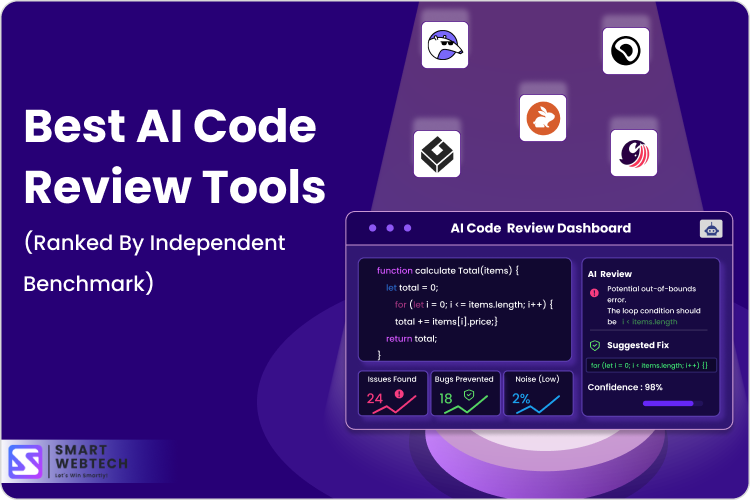
The best AI code review tools in 2026 are CodeRabbit, Qodo, Macroscope, SonarQube, and Greptile. Here is what each one does best and who it is built for.
1. CodeRabbit
CodeRabbit is an AI-native pull request reviewer that integrates directly with GitHub, GitLab, and Bitbucket and begins posting review comments within seconds of a PR being opened. It summarizes the full diff, flags bugs, suggests improvements, and learns from developer feedback over time. Setup takes under five minutes.
The free tier covers unlimited public repositories and 30 PRs per month on private repos, making it the most accessible starting point for small teams. Pricing for private repositories starts at $12 per developer per month.
- Best for: Small to mid-size teams that want fast, broad coverage without a lengthy procurement process
- Pricing: Free tier available, $12/dev/month for private repos
- Platforms: GitHub, GitLab, Bitbucket
2. Qodo
Qodo (formerly CodiumAI) focuses on test generation and deep logic analysis alongside pull request review. It identifies edge cases, suggests test coverage for new code paths, and provides context-aware suggestions that reflect the intent of the surrounding codebase.
Qodo integrates with GitHub, GitLab, and Azure DevOps and offers SOC 2 Type II compliance documentation for enterprise customers. Pricing starts at $19 per developer per month, with an enterprise tier available for procurement through direct sales.
- Best for: Enterprise teams that need compliance documentation and AI-generated test coverage built into their review workflow
- Pricing: $19/dev/month, enterprise on request
- Platforms: GitHub, GitLab, Azure DevOps
3. Macroscope
Macroscope v3, released in February 2026, achieves 98% precision, meaning nearly every comment it posts is actionable, while detecting 3.5 times more production-critical bugs than its previous version, with overall comment volume down 22%. Those numbers come from the Martian Code Review Bench, the first independent benchmark in the category.
Macroscope uses a multi-agent architecture that runs parallel analysis passes for security, logic, and style separately before merging results, which is what drives its precision advantage. It supports GitHub and GitLab, with Bitbucket support in beta.
- Best for: Teams where false positives are a serious problem and developer trust in the tool has eroded from previous bad experiences
- Pricing: On request for teams above 20 developers
- Platforms: GitHub, GitLab (Bitbucket in beta)
4. SonarQube
SonarQube is the most established tool on this list and the one most likely to already be in your stack. It combines deterministic rule-based SAST with newer AI-assisted analysis to cover code quality, security vulnerabilities mapped to OWASP Top 10 and SANS Top 25, and technical debt tracking. The Community Edition is free and self-hosted. The Developer Edition starts at approximately $150 per year for small teams.
SonarQube supports all major languages, all major platforms, and all major CI/CD pipelines. It is not the most cutting-edge AI reviewer on this list, but it is the most proven and the easiest to justify to a compliance officer or auditor.
- Best for: Regulated industries (BFSI, healthcare, government) and any team that needs a long audit trail with deterministic, explainable findings
- Pricing: Free (Community), ~$13/dev/month (Developer Edition)
- Platforms: GitHub, GitLab, Bitbucket
5. Greptile
Greptile indexes your entire codebase, not just the diff, and uses that full-context understanding to generate review comments that reflect how a change interacts with the rest of the system. It flags issues that diff-only tools miss entirely, such as a function change that breaks an assumption made in a module the reviewer never opened.
Greptile is backed by Y Combinator and has been gaining traction in teams with large, complex monorepos. It supports GitHub and GitLab. Pricing starts at $25 per developer per month.
- Best for: Teams working in large codebases where the most important bugs are architectural and cross-module rather than localized to the changed lines
- Pricing: $25/dev/month
- Platforms: GitHub, GitLab
Which Tool Is Right for Your Team?
The best AI code review tools in 2026 serve different team profiles, and using the wrong one for your context costs more in wasted setup time and developer frustration than it saves in bugs caught.
| Team Profile | Primary Tool | Primary Tool |
|---|---|---|
| Startup / small team (1-15 devs) | CodeRabbit | Free tier, 2-click setup on GitHub |
| Scale-up (15-100 devs) | CodeRabbit or Qodo | Greptile if AI-generated code is above 50% of commits |
| Enterprise | Qodo + SonarQube | Run both in parallel for coverage and compliance |
| Regulated industry | SonarQube | Layer Macroscope or Codacy if you need on-prem AI context |
| Open-source maintainers | CodeRabbit or Semgrep | Both are free for public repos |
| AI-heavy codebase (40%+ AI commits) | Greptile | Full-codebase indexing catches cross-module inconsistencies |
Related Read
Using Cursor, Copilot, or Claude Code heavily? Your AI-generated code may need cleanup and refactoring before AI review tools can properly analyze it.
Read our complete guide to vibe code fixing and refactoring →How to Set Up Your First AI Code Review Tool
CodeRabbit
- Go to coderabbit.ai and sign in with your GitHub or GitLab account
- Select your repository and install the GitHub App or GitLab integration
- Open a pull request, CodeRabbit posts its first review automatically
No configuration required to get started. The settings file (coderabbit.yaml in your repo root) lets you tune behavior once you have a feel for the defaults.
SonarQube Community
- Download the Community Edition from sonarqube.org
- Run it via Docker using the standard SonarQube image
- Configure your CI pipeline using the available GitHub Actions or GitLab CI templates
- Connect the scanner to your SonarQube server URL and project key
First analysis typically runs within an hour of completing setup.
Qodo enterprise pilot
Contact Qodo’s sales team directly for a structured pilot. Enterprise pilots typically run four to six weeks, include ROI measurement against your team’s baseline defect escape rate and review cycle time, and come with a dedicated onboarding engineer. This is the right path if you need stakeholder buy-in before committing to a contract, because the pilot generates the data you need to make the business case.
Ready to Stop Drowning in Review Noise and Start Shipping With Confidence?
You are generating more code than ever. GitHub Copilot, Cursor, and Claude Code are working. The problem is that your review process was built for a world where humans wrote every line, and that world is gone.
That is where most engineering teams find themselves in 2026. Not in crisis, but at the inflection point where the old review workflow is visibly slowing down a team that is otherwise moving fast.
Smart WebTech helps you set up the right AI code review stack for your specific codebase, your platform, your team size, and your compliance requirements. Not a generic tool recommendation you have to implement yourself. An actual setup, configured, tuned, and integrated into your CI/CD pipeline so your team starts getting signal instead of noise from day one.
If your codebase is ready for a review process that scales with it, let’s talk about what that looks like for your team.
Connect with Smart WebTech to get started.