

Logistics & Transportation App Development: Process, Features & Cost
Learn everything about logistics & transportation app development, from process and features to cost, types, and how to start building your app today.
 21 min read
 May 29, 2026


Think about the last time you ordered food and watched it move from the restaurant to your door on a live map or checked your train’s live location while waiting at the platform. That is the power of logistics and transportation apps, and it is happening everywhere around you.
According to Grand View Research, the global digital logistics market was valued at USD 33.79 billion in 2024 and is further expected to reach USD 93.28 billion by 2030, growing at a CAGR of 18.8%. That is not a slow climb; that is, in fact, an explosion of opportunity.
So whether you are a startup planning to build the next big delivery platform, a transport business that wants to digitize its fleet, or an entrepreneur looking to create a freight marketplace, then this is the perfect place for you.
This guide is written for you. Specifically, we will walk through everything from what these apps actually are to how to build one, what features to include, and how much it costs.
What Are Logistics & Transportation Apps?
At the most basic level, a logistics and transportation app is a mobile application that helps businesses and customers manage the movement of goods or people from one place to another, digitally, efficiently, and in real time.
Before these apps existed, everything was manual. For instance, dispatch was done over phone calls. Drivers were tracked by calling them on the road. Delivery updates were given only when the driver reached the destination. As a result, paperwork piled up. Errors were constant. Customers were kept in the dark.
Today, however, a single mobile app handles all of this automatically and much more. It connects drivers, dispatchers, customers, and business managers through one shared platform where everything is visible, trackable, and actionable in real time.
Logistics Apps vs. Transportation Apps: What is the Difference?
This is one of the most commonly confused topics. While logistics and transportation are closely related, they are not the same thing. Understanding the difference helps you build the right app for your specific business.
What is logistics app development?
Logistics software development focuses on managing the movement of goods, from picking up a product at a warehouse to moving it through multiple checkpoints to delivering it at the customer’s doorstep. In other words, it is all about cargo, shipments, parcels, freight, and inventory.
Real-world examples of logistics apps:
- Delhivery: manages parcel pickup, sorting, transit, and last-mile delivery across India
- FedEx App: allows businesses and customers to book, track, and manage shipments globally
- Blackbuck: connects truck owners and transporters for freight booking and fleet management
- Porter: on-demand mini truck and bike delivery for businesses and individuals
- Shadowfax: hyperlocal last-mile delivery for e-commerce brands
- Dunzo: instant delivery of groceries, medicines, and packages within a city
In short, if the app is primarily about moving goods, packages, freight, or cargo, it is a logistics app.
What is transportation app development?
On the other hand, a transport management app focuses on moving people or vehicles, booking a ride, tracking a bus, managing a fleet of cabs, or scheduling employee transport. It is about passengers, vehicles, routes, and travel.
Real-world examples of transportation apps:
- Uber & Ola: on-demand cab booking with live tracking and fare calculation
- Rapido: two-wheeler bike taxi booking for short city distances
- RedBus: bus ticket booking with seat selection and real-time bus tracking
- Zoomcar: self-drive car rental with vehicle unlock via app
- GSRTC / KSRTC Bus Apps: government bus tracking and ticket booking
- Baloora: school bus tracking app that notifies parents when the bus is near
- Meru Cabs: corporate cab booking and employee transport management
In short, if the app is primarily about moving people, managing vehicles, or booking rides, it is a transportation app.
Where They Overlap
In practice, however, many apps combine both. A company like Swiggy, for example, runs transportation (the delivery partner rides to the restaurant and to your home) and logistics (managing orders, routing, dispatch, and delivery confirmation) within a single app.
Similarly, a freight platform like Uber Freight handles both the transportation of goods (trucks moving cargo) and the logistics side (booking, tracking, billing, and compliance).
That is precisely why the terms “logistics” and “transportation app” are used together, because modern platforms almost always need to handle both.
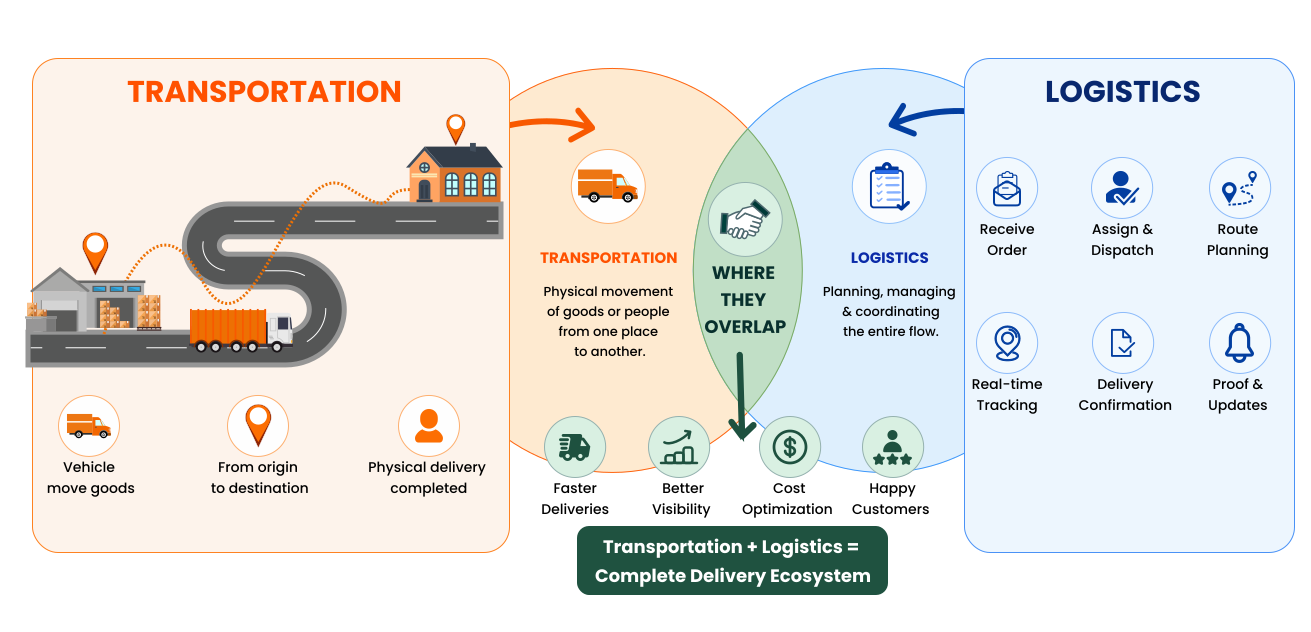
In addition, a Transportation Management System (TMS), which is fundamentally a transportation technology, is widely considered a core component of logistics and supply chain management. As industry sources confirm, a TMS helps businesses plan, execute, and optimize the movement of goods, making it an essential logistics tool.
The two disciplines are therefore deeply connected at the operational level, which is why modern platforms almost always serve both and why this guide covers them together.
Why Your Business Needs a Logistics & Transportation App
No matter which industry you operate in, e-commerce, retail, pharma, food, freight, mining, or passenger transport, if your business involves moving anything from one place to another, you need an app. Here is why.
The traditional way of running logistics and transportation operations is full of problems that silently, yet consistently, drain money, time, and customer trust every single day.
Common challenges businesses face without an app:
- Dispatchers have to call drivers constantly to know where they are
- Customers keep asking, “Where is my order?” because there is no tracking
- Route planning is done manually, consequently leading to fuel waste and longer delivery times
- Paper-based proof of delivery gets lost, thereby creating billing disputes
- There is no data to understand which routes are efficient and which are not
- Driver performance cannot be monitored without a digital system
- Booking and scheduling are done over WhatsApp or phone calls, often leading to errors
- Late deliveries go undetected until the customer complains
Each one of these problems costs money. And more importantly, each one of them can be solved with a well-built mobile app.
On the other side, businesses that have built logistics and transportation apps report faster delivery times, better customer satisfaction, lower operational costs, and significantly less manual work. According to AI-powered logistics platforms, they have furthermore demonstrated the ability to cut operational costs by up to 30% through automation and intelligent dispatch management.
The opportunity is clear. The only question is therefore how to build the right app.
Types of Logistics & Transportation Apps
Before jumping into development, it is important to understand which type of app best matches your business. After all, each type solves a different problem for a different audience.
| App Type | What It Does | Who Needs It |
|---|---|---|
| On-Demand Cab / Ride Booking App | Connects passengers with drivers for instant or scheduled rides | Taxi companies, ride-sharing startups |
| Last-Mile Delivery App | Manages the final leg of delivery from warehouse to customer’s door | E-commerce brands, courier companies, quick commerce |
| Freight & Truck Booking App | Connects shippers with truck owners for cargo movement | Freight brokers, transporters, logistics startups |
| Fleet Management App | Tracks and manages a company’s entire vehicle fleet in real time | Any business that owns or operates vehicles |
| Parcel & Courier Tracking App | Allows customers to track individual shipments at every stage | Courier companies, postal services |
| Warehouse & Inventory App | Manages stock levels, order picking, and dispatch from a warehouse | Distributors, manufacturers, 3PL companies |
| Cold Chain Logistics App | Monitors temperature-sensitive goods during transit | Pharma companies, food distributors, dairy |
| Bus & Public Transport App | Provides live bus tracking, route information, and ticket booking | Government transport bodies, private bus operators |
| Employee Transport App | Manages company cab bookings and employee pickup/drop schedules | Corporates, IT parks, BPOs |
| Supply Chain Visibility App | Provides end-to-end visibility across an entire supply chain | Large manufacturers, importers, exporters |
| Industrial Fleet App | Manages vehicle dispatch, weighment, and material tracking in industrial settings | Mining, cement, steel, bulk material companies |
Knowing which type you are building is ultimately the foundation of the entire development process.
Logistics & Transportation App Development: A Step-by-Step Process
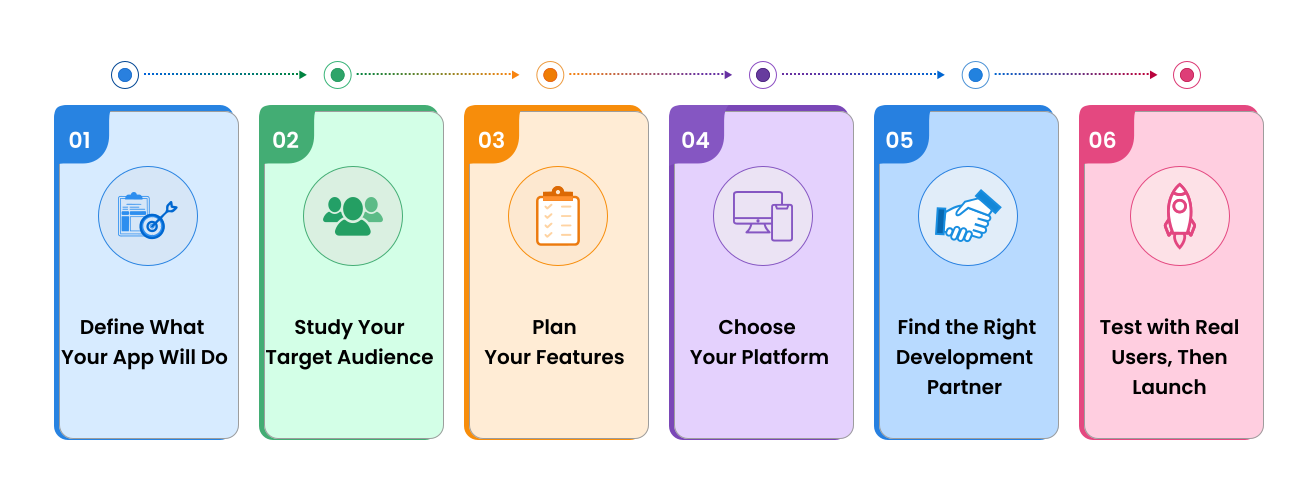
Building a logistics or transportation app is not just about writing code. Rather, it is a process that starts long before a single line is written. Here is a clear, step-by-step path from idea to launch.
Step 1: Define What Your App Will Do
The first and most important step is to get very specific about what problem your app solves and for whom. This sounds simple, but in reality, most failed app projects can trace their problems back to a vague or unclear objective at this stage.
Ask yourself these questions clearly:
- Is my app for moving goods or moving people, or both?
- Who are the main users, customers, drivers, dispatchers, or all three?
- Am I building for my own business operations or a platform for others to use?
- What is the single biggest pain point I want to eliminate?
For example, a logistics startup might define its objective as “We want to build an app that lets small businesses in Tier 2 cities book trucks within 30 minutes and track deliveries in real time.“ That is specific. That is actionable. And everything that gets built flows from that clarity.
Step 2: Study Your Target Audience
Once you know what you are building, the next step is to deeply understand who will use it. A logistics app has at least three different user types, and each one uses the app differently.
The customer or shipper wants a clean, simple experience: book, track, pay, done. Meanwhile, the driver or delivery partner needs a mobile-first interface that works even on a basic Android phone, with large buttons, clear navigation, and offline support.
In contrast, the admin or operations manager needs a powerful dashboard with live maps, reports, and alert systems. Building the right experience for each user type is ultimately what separates apps people actually use from apps that get uninstalled after a week.
Step 3: Plan Your Features
With your audience understood, the next step is to create a prioritized feature list. A useful way to do this is to divide features into three buckets:
- Must-have features (MVP): the bare minimum needed to go live and deliver value. For a delivery app, this means booking, GPS tracking, proof of delivery, and payment.
- Important features (Version 2): features that improve the experience significantly but are not needed on day one. These include route optimization, in-app chat, rating systems, and analytics dashboards.
- Advanced features (Version 3+): features like AI-based demand forecasting, cold chain monitoring, or crowdsourced delivery are added only after the app has proven itself with real users.
This phased approach means you can launch faster, learn from real usage, and subsequently invest further development budget where it act
Step 4: Choose Your Platform
One of the most common early decisions is whether to build for Android, iOS, or both. In India and most of Southeast Asia, Android dominates, particularly among driver-side users who typically use affordable Android smartphones. In Western markets and among corporate users, iOS has a stronger share.
The practical recommendation for most logistics and transportation apps is to go cross-platform, using technologies like React Native or Flutter, so that one codebase serves both Android and iOS users. This reduces development cost significantly without compromising on quality.
Additionally, most enterprise-facing logistics apps also need a web-based admin panel, a browser-accessible dashboard for dispatchers and managers who work from desktops.
Step 5: Find the Right Development Partner
Unless you have a strong in-house technical team, finding the right development company is one of the most important decisions you will make. After all, you are not just hiring people who write code; you are hiring people who understand logistics workflows, mobile UX best practices, and real-world operational requirements.
When evaluating a development partner, be sure to pay attention to:
- Their portfolio of logistics or transportation apps
- Whether they have experience with GPS integration, mapping APIs, and payment gateways
- Their design capability and logistics apps need to be functional, fast, and easy to use
- Their post-launch support model: apps need ongoing maintenance, not just a one-time build
Step 6: Test with Real Users, Then Launch
Before going live, test your app with the actual people who will use it, not just your internal team. For instance, give it to a few real drivers. Have actual customers try to book a delivery. Ask your dispatcher to use the admin panel for a day.
Real users will find problems that your development team will never discover in a testing environment. A button that is too small for a driver wearing gloves. A screen that is confusing when the phone is in bright sunlight. A notification that fires at the wrong time. These are the issues that cause users to abandon apps, and they are all fixable before launch if you catch them in testing.
After a solid testing phase, launch with a focused pilot group, gather feedback, and iterate before scaling to your full user base.
Core Features of a Logistics & Transportation App
Every logistics and transportation app, regardless of whether it is a cab booking app, a delivery platform, or a freight marketplace, is built around three panels. Here is what each one needs.
Admin Panel
The admin panel is the control center of the entire operation. The people who use it are dispatchers, operations managers, and business owners, and they need complete visibility over everything happening in the field.
- Live Operations Dashboard: Think of it as a control room for your entire logistics or transportation business. Whether you are running 10 delivery bikes or 500 freight trucks, the live dashboard gives you one single screen where everything is visible: active trips, vehicle locations on a live map, pending orders, completed deliveries, driver statuses, and any real-time alerts.
- Vehicle & Fleet Management: The admin should be able to see all registered vehicles, their current status (active, idle, under maintenance), their assigned drivers, and their live location on a map. This feature is central to both logistics apps (delivery vans and trucks) and transportation apps (cabs and buses).
- Driver & Delivery Partner Management: Managing drivers efficiently requires a complete profile for each one, including name, contact, license details, assigned vehicle, current status, and performance history. The admin should be able to add, edit, deactivate, and reassign drivers from a single screen.
- Trip & Order Management: Every booking or dispatch creates a trip. The admin panel should show all active, scheduled, and completed trips in one place, with the ability to filter by date, driver, vehicle, route, or status. Furthermore, the admin should be able to manually assign or reassign trips when needed.
- Live GPS Map View: A live map showing all vehicles moving in real time is one of the most valuable tools for an operations manager. It allows instant identification of delays, route deviations, and idle vehicles without making a single phone call.
- Reports & Analytics: At the end of each day, week, or month, the admin needs data, delivery completion rates, average trip times, driver performance scores, revenue summaries, and exception reports. These reports should be auto-generated and exportable.
- Push Notifications & Alerts: The admin should receive instant alerts for critical events, a vehicle sitting idle for too long, a delivery running significantly behind schedule, or a driver deviating from the assigned route. Proactive alerts allow issues to be resolved before they become complaints.
Customer / User Panel
The customer panel is what end users interact with. Whether the “customer” is a passenger booking a ride, a business placing a shipment, or an individual tracking a parcel, this panel needs to be clean, intuitive, and fast.
- Easy Sign-Up & Login: Registration should take less than a minute. Offering OTP-based login, Google sign-in, or social media login reduces friction and increases the number of users who actually complete sign-up.
- Booking & Order Placement: Customers should be able to place a request in a few taps, entering pickup location, destination, type of service, and any additional details. The app should show available options, estimated time, and fare upfront, so there are no surprises.
- Real-Time Tracking: Once a booking is confirmed, the customer should be able to see the driver’s live location on a map, get a real-time ETA, and receive updates at every key milestone.
- Payment & Invoice: The payment experience should be seamless. Supporting multiple methods, UPI, cards, wallets, net banking, and cash ensures that no customer drops off at the payment step. After every completed trip or delivery, a digital invoice should be automatically generated and sent to the customer.
- Delivery Status Notifications: Throughout the journey of a delivery or ride, the customer should receive automatic push notifications: booking confirmed, driver assigned, pickup done, in transit, arriving soon, and delivered. Each notification keeps the customer informed without them having to open the app repeatedly.
- Ratings & Feedback: After every completed trip or delivery, customers should be invited to rate their experience and leave comments. This feedback loop is invaluable; it surfaces driver performance issues, operational problems, and feature gaps that would otherwise go unnoticed.
Driver / Delivery Partner Panel
The driver app is used in the field, often while moving, in varying lighting and connectivity conditions. Therefore, simplicity and reliability are non-negotiable.
- Driver Registration & Document Upload: Drivers should be able to register using their phone number and upload required documents such as their driver’s license and vehicle registration. This creates a verified, trustworthy driver base.
- Trip & Delivery Queue: The driver’s home screen should clearly show their current assignment, pickup address, customer contact, navigation button, and a list of upcoming scheduled trips. Everything the driver needs for their day should be available at a glance.
- In-App Navigation: The driver app should include turn-by-turn navigation, ideally integrated with Google Maps or a similar mapping service. For delivery apps, the navigation should account for delivery sequence, guiding the driver through multiple stops in the most efficient order.
- Electronic Proof of Delivery (ePOD): Instead of paper delivery receipts that can get lost or forged, drivers should confirm delivery digitally by capturing a photo of the delivered goods, scanning a barcode, or collecting a digital signature from the recipient. This data is immediately stored and available to the admin and customer.
- Earnings & Trip History: Drivers should be able to see their completed trips, earnings for the day/week/month, and pending payments, all from within the app. Transparent earnings visibility increases driver trust and reduces support queries.
- In-App Communication: An in-app calling or chat feature allows drivers to contact customers or the admin without using personal phone numbers. It keeps communication organized and creates a record of every conversation.
- Push Notifications: Drivers need to be notified of new trip assignments, customer messages, schedule changes, and important alerts, even when the app is running in the background.
Advanced Features That Make Your App Stand Out
Beyond the core panels, certain advanced features dramatically improve the operational efficiency and user experience of a logistics or transportation app. These are the features that separate a good app from a great one.
GPS Tracking & Geo-Fencing
Live GPS tracking is the heartbeat of any logistics or transportation app. But beyond simply showing a dot moving on a map, a truly useful GPS module includes geofencing, the ability to define geographic boundaries and trigger automatic alerts when a vehicle enters or exits them.
Route Optimization
Manual route planning for multiple deliveries is slow, inefficient, and expensive. A route optimization engine automatically calculates the most efficient sequence and path for completing multiple pickups and drop-offs, factoring in real-time traffic, vehicle capacity, customer time windows, and fuel costs.
Crowdsourced Delivery
An increasingly popular feature in on-demand logistics apps is the ability to crowdsource deliveries during peak hours, assigning orders to freelance delivery partners rather than only in-house staff. This helps businesses scale their delivery capacity on demand without the cost of maintaining a large permanent fleet.
In-App Chat & Communication
Keeping communication within the app, rather than relying on personal phone numbers, serves two important purposes. First, it protects the privacy of both drivers and customers. Second, it creates a traceable record of every conversation, which is valuable for resolving disputes and improving service quality.
Cold Chain Monitoring
For businesses that transport temperature-sensitive goods, such as medicines, vaccines, dairy products, frozen food, or fresh produce, cold chain monitoring is a critical feature. IoT sensors placed inside the delivery vehicle continuously track temperature and humidity during transit and send real-time data to the app.
If the temperature rises above or drops below the acceptable range, the system immediately alerts the driver and the admin, allowing corrective action before the goods are spoiled.
Real-Time Alerts & Exception Management
A proactive alert system monitors the operation continuously and notifies the right person the moment something goes wrong. Rather than discovering a problem after it has already caused damage, the team is alerted in time to act.
Common alerts that should be configurable in a logistics or transportation app include:
- Vehicle idle for more than a defined time period
- Route deviation beyond a set distance
- Delivery running more than X minutes behind schedule
- The driver is not moving but trip is marked as active
- GPS signal lost for a vehicle in transit
- Vehicle speed exceeding the defined limit
- Order not delivered within the promised time window
As your app accumulates operational data over time, an AI analytics layer can convert that raw data into meaningful business intelligence. Rather than manually reviewing reports, the AI engine identifies patterns and surfaces insights automatically.
Practical examples of AI-powered insights in logistics and transportation apps include predicting which routes will experience delays based on historical data, forecasting delivery demand for the next day to help pre-assign drivers, identifying which drivers consistently underperform on delivery times, and detecting anomalies in vehicle movement that may indicate misuse or mechanical issues.
KPI Dashboard for Management
Beyond day-to-day operations, management needs a high-level view of how the business is performing over time. A KPI (key performance indicator) dashboard provides this, displaying the most important performance metrics in one clear, visual screen.
| KPI Category | Key Metrics to Track |
|---|---|
| Delivery Performance | On-time delivery rate, average delivery time, failed delivery rate |
| Fleet Efficiency | Vehicle utilization rate, average idle time, fuel efficiency per trip |
| Driver Performance | Trips completed per driver, average rating, late delivery frequency |
| Customer Experience | Average customer rating, repeat booking rate, complaint resolution time |
| Financial Performance | Revenue per trip, cost per delivery, monthly revenue trend |
A management team that has access to this data can make faster, better decisions and spot operational problems before they become financial ones.
Multi-Language & Multi-Currency Support
For logistics and transportation apps operating across multiple cities, states, or countries, multi-language and multi-currency support is essential.
A delivery driver in Tamil Nadu should be able to use the app in Tamil. A business operating freight routes from India to the Middle East needs to handle invoices in multiple currencies.
How Much Does It Cost to Build a Logistics & Transportation App?
Development cost depends on the type of app, the number of features, the platforms targeted, and the development team’s location and experience. The following table provides a realistic range for different app types.
| App Type | Features Included | Estimated Cost |
|---|---|---|
| Basic Tracking App | GPS tracking, driver app, simple admin panel | USD 20,000 – 40,000 |
| Cab / Ride Booking App | Booking, live tracking, fare calculation, payments, ratings | USD 40,000 – 80,000 |
| Last-Mile Delivery App | Driver + customer + admin panels, route optimization, ePOD, notifications | USD 50,000 – 100,000 |
| Freight Marketplace App | Shipper + transporter matching, load board, live tracking, billing | USD 80,000 – 150,000 |
| Fleet Management Platform | Multi-vehicle tracking, driver management, fuel analytics, KPI dashboard | USD 60,000 – 120,000 |
| Cold Chain Logistics App | All delivery features + IoT temperature monitoring + compliance reporting | USD 100,000 – 200,000 |
| Enterprise Supply Chain App | End-to-end visibility, AI analytics, multi-location, integrations | USD 200,000 – 500,000+ |
A logistics delivery app in the US typically starts at USD 40,000–100,000, with AI-driven route optimization or advanced features pushing costs higher. A full-scale freight marketplace with advanced logistics features typically ranges from USD 150,000 to USD 200,000 and above.
Key factors that affect development cost:
- Number of user panels (admin, customer, driver, management)
- Platform choice, Android only, iOS only, or cross-platform
- Number of third-party integrations (maps, payments, IoT, analytics)
- Whether offline functionality is required
- Level of AI and analytics capability
- Post-launch maintenance and support
Conclusion
The world is not going back to phone calls and paper registers. Every industry is going digital, and logistics and transportation are moving faster than most. Whether it is a cab arriving at your door in 3 minutes, a parcel tracked across 1,200 kilometers in real time, or a fleet of trucks dispatched and monitored from a single mobile screen, it is all powered by well-built apps.
As this guide has shown, every logistics and transportation app, regardless of type, shares one core goal: making the movement of goods and people faster, smarter, and more transparent.
The market opportunity is large and growing. The technology to build powerful, scalable apps is more accessible than ever. And the businesses that invest in the right digital tools today are the ones that will lead their category tomorrow.
Ready to build your logistics or transportation app? Contact us today for a free consultation and let us help you turn your idea into a fully working app.